AI · 9 min
Why AI Solutions Work in Development but Fail in Production
An AI solution that works in development is not automatically ready for production. Here are the seven gaps enterprises must close across ownership, evaluation, security, integration, adoption, operations, and cost.

Amrutha Satishkumar
August 18, 2026
The most dangerous moment is when it works in development
There is a specific moment in almost every AI project that feels like success and is actually the start of the hardest work. The solution runs in the development environment. The question gets a good answer. The team sees the intended behavior. Someone says the sentence that quietly reshapes the timeline: “This is basically done, right?”
It is not done. It is barely started.
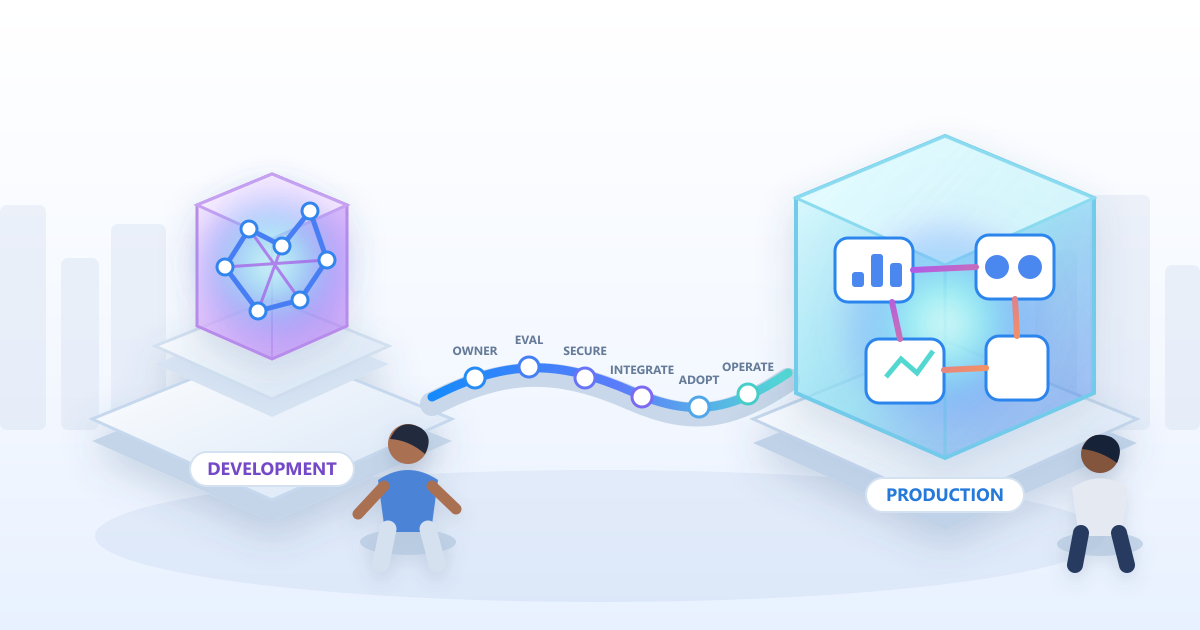
Development proves that the solution can work. Production proves that it can remain reliable, safe, supportable, and worth paying for over time. Those are different claims, and the distance between them is where many AI initiatives stall. Development optimizes for learning and controlled iteration. Production has to survive thousands of uncontrolled interactions.
This article is about that distance. Not to diminish what the development team achieved, but to name what production requires so teams can plan for the real work instead of being surprised by it.
Development optimizes for learning, production optimizes for trust
The reason development success can mislead us is not poor engineering. It is scope.
A development environment is built to answer a focused question: can we make this capability work? To answer it quickly, teams use controlled data, known examples, test identities, and observable happy paths. Production introduces real permissions, audit requirements, failure handling, changing data, unpredictable requests, and users who were not in the design session. The development approach is appropriate for learning, but it does not prove production readiness.
But an enterprise does not buy possibility. It buys trust. And trust is not a feature you add at the end. It is the sum of many properties that have to be designed in from the start: correctness you can measure, access you can enforce, failures you can see, ownership you can name, and cost you can predict.
When a solution works in development, we have shown that the ceiling is high enough. Production is about raising the floor so the system behaves acceptably on its worst day, not just its best one.
The seven gaps between development and production
The distance from development to production is not one big leap. It is seven specific gaps. A solution can look complete in development while every one of them is still open.
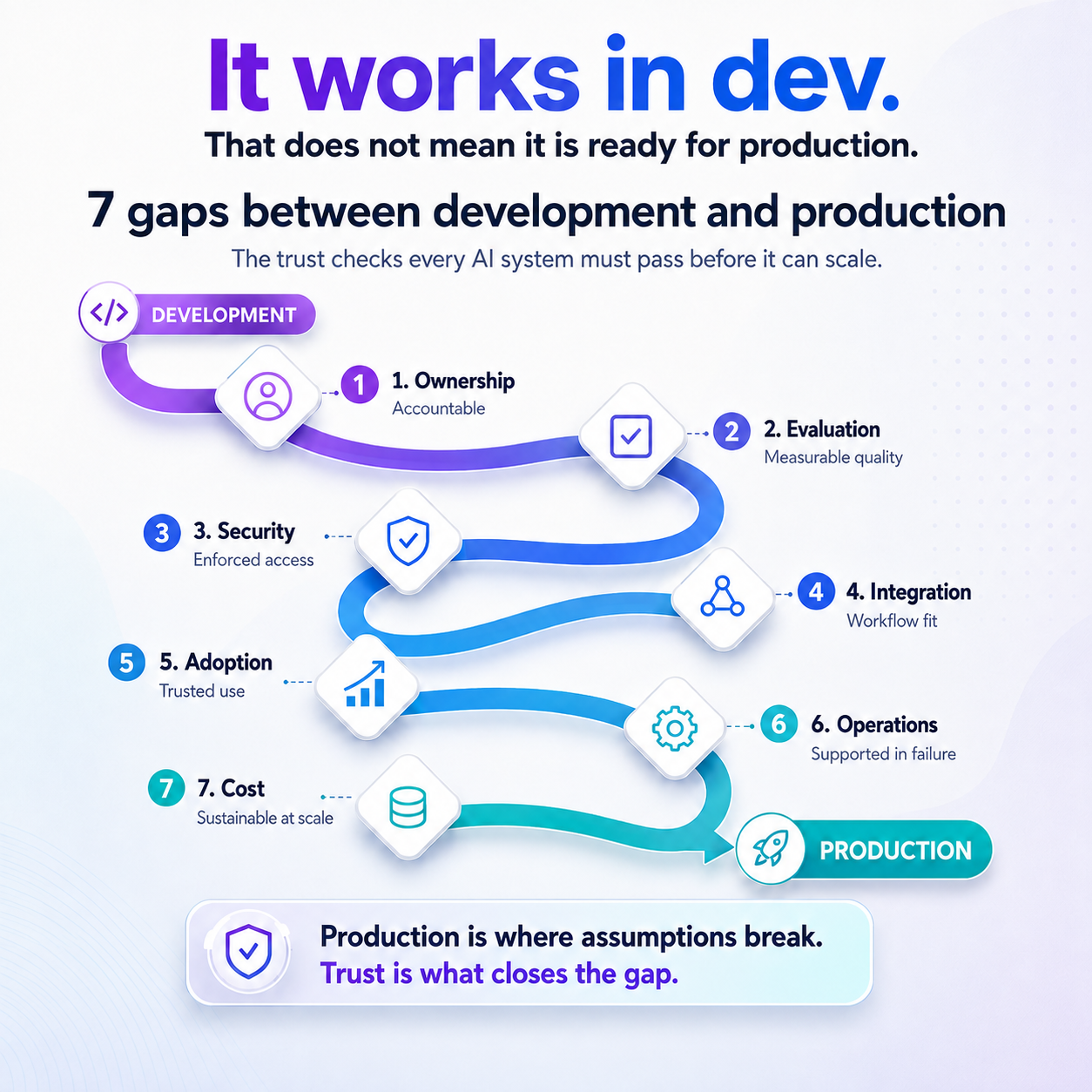
1. Ownership
In development, ownership can appear simple because a small team builds, runs, and troubleshoots the solution. In production, that team cannot be the answer to every question at 2 a.m.
An enterprise system needs a named owner for the model behavior, the data it depends on, the infrastructure it runs on, and the decisions it influences. Ownership is not a formality. It determines who is accountable when an answer is wrong, who approves a change, and who decides when the system should be paused. A capability with no owner is not a system. It is a liability waiting for an incident.
2. Evaluation
Development testing often confirms that expected examples produce useful results. Production evaluation has to prove much more.
Real evaluation means you can score the system’s answers against known-good outcomes, measure how often it is right, and detect when quality drifts over time. It means having a test set that includes the easy questions, the ambiguous ones, the ones with no valid answer, and the ones designed to make the system fail. If you cannot measure quality, you cannot improve it, defend it, or notice when it degrades. Reliability is not a final testing phase. It is a continuous practice, and it starts with the ability to keep score.
3. Security and access
Development environments often use simplified access because the immediate goal is to test behavior. That is precisely the property an enterprise cannot carry into production.
A production AI system has to inherit and respect the same access controls as the people it serves, including row-level and column-level security. It cannot become a side door that returns data a user would never be allowed to see directly. It has to handle identity, honor governance policy in context, and avoid leaking sensitive information through a helpful-sounding answer. The moment a system can act or retrieve on someone’s behalf, its access model becomes a security surface, not a convenience.
4. Integration
In development, inputs and outputs can be controlled directly by the team. In production, the system has to plug into workflows people already use, pull from sources that change, and hand its output to the next step without a human copying and pasting in between.
Integration is where much of the unglamorous engineering lives: connectors, authentication, data contracts, error handling when an upstream source is late or malformed, and the retries and fallbacks that keep a workflow moving. A capability that only works when the development team guides each step is not production-ready. A system earns its place by fitting into the flow of real work.
5. Adoption
A technically correct system that no one uses has failed just as completely as one that gives wrong answers.
Adoption is not automatic, and it is not created by accuracy alone. People adopt a system when they trust it, when it fits how they already work, when it is fast enough to not break their momentum, and when leadership signals that it is the expected way to do the job. Development users understand the system’s intent and limitations. Production users are busy, skeptical, and quick to abandon a tool that wastes their time once. Winning them is a design and change-management problem, not only an engineering one.
6. Support and operations
Development has the engineering team nearby. Production has a pager.
Once a system is real, someone has to watch it. Pipelines fail, data drifts, models behave differently as inputs change, and dependencies break without warning. Observability is what turns a silent failure into a caught one. Operations is what turns a caught failure into a fixed one. This means monitoring, alerting, runbooks, a way to roll back a bad change, and a clear path for a user to report that something looks wrong. If nobody is watching the system, it is not in production. It is just unattended.
7. Cost
Development cost is usually bounded by a small workload. A production system’s cost is a line item that someone has to justify every quarter.
Cost at scale is not the same shape as cost in development. It includes compute for every real request, storage and movement of the data the system depends on, the human time to operate and improve it, and the compounding expense of inefficient patterns repeated thousands of times a day. A system that is useful but uneconomical does not survive its first budget review. Cost predictability is part of being production-ready, not an afterthought.
Why the gap is invisible until it is expensive
Here is the uncomfortable part. Every one of these gaps is easy to understate in development because the environment is designed for iteration, not operational scale. That is what makes the transition so dangerous. The controls that made development fast and observable can hide the real cost of operating the system.
Momentum makes it worse. Development success creates confidence, and confidence creates commitments. Timelines get set based on how complete the solution feels, not on how far production readiness actually is. By the time the gaps surface, they appear as missed dates, security reviews that stall the launch, users who quietly stop logging in, and a bill that nobody forecasted.
The gaps do not go away because we did not plan for them. They just move downstream, where they are more expensive and more visible.
The question to ask before moving to production
The most useful thing a team can do when the solution works in development is resist the sentence “this is basically done” and replace it with a better question:
What would it take for someone to trust this system on its worst day, not just watch it on its best one?
That single reframe pulls all seven gaps into view. It forces the conversation past the impressive output and toward ownership, evaluation, security, integration, adoption, support, and cost. It changes the goal from proving the ceiling is high to raising the floor.
A short checklist to run in that moment:
- Who owns this system, its data, and the decisions it shapes?
- How will we measure whether its answers are actually right, and notice when they stop being right?
- Does it respect the same access rules as the people it serves?
- Does it fit into a real workflow without a human in the middle copying and pasting?
- Will people trust it and use it, and what would make them stop?
- Who watches it, and what happens when it fails?
- What does it cost at real scale, and can we predict that cost?
If the honest answers are unclear, the system is not late. It is at the beginning of the production-readiness work that development was never meant to complete.
Closing thought
Development success and production readiness are two different claims. One says the solution works under controlled conditions. The other says the organization can trust it under real ones.
The teams that win with AI are not the ones that move from development to production fastest. They are the ones that understand what must change between the two. They treat development success as evidence that the capability works, then do the engineering and operating-model work required to make it trustworthy.
Possibility is where AI projects begin. Trust is where they become systems.
Amrutha Satishkumar
Data & AI Solution Engineer at Microsoft