Data & AI · 7 min
Why AI Solutions That Work in Development Fail to Become Enterprise Systems
Help enterprise AI sponsors and technical teams distinguish development success from production readiness, then give them a practical framework for closing

Amrutha Satishkumar
August 18, 2026
The most dangerous moment is when the solution first works in development
The answer appears in seconds. It sounds informed. The retrieval works. The agent calls the right tool. Everyone in the room can imagine the finished product.
Then someone asks, “How quickly can we put this into production?”
That question often arrives too early.
A successful result in development proves that an AI capability can create value under selected conditions. An enterprise system must create that value repeatedly, for different users, with changing data, enforced permissions, measurable quality, predictable cost, and a team prepared to respond when it fails.
The gap is not simply a better prompt. It is the engineering and operating system around the capability.
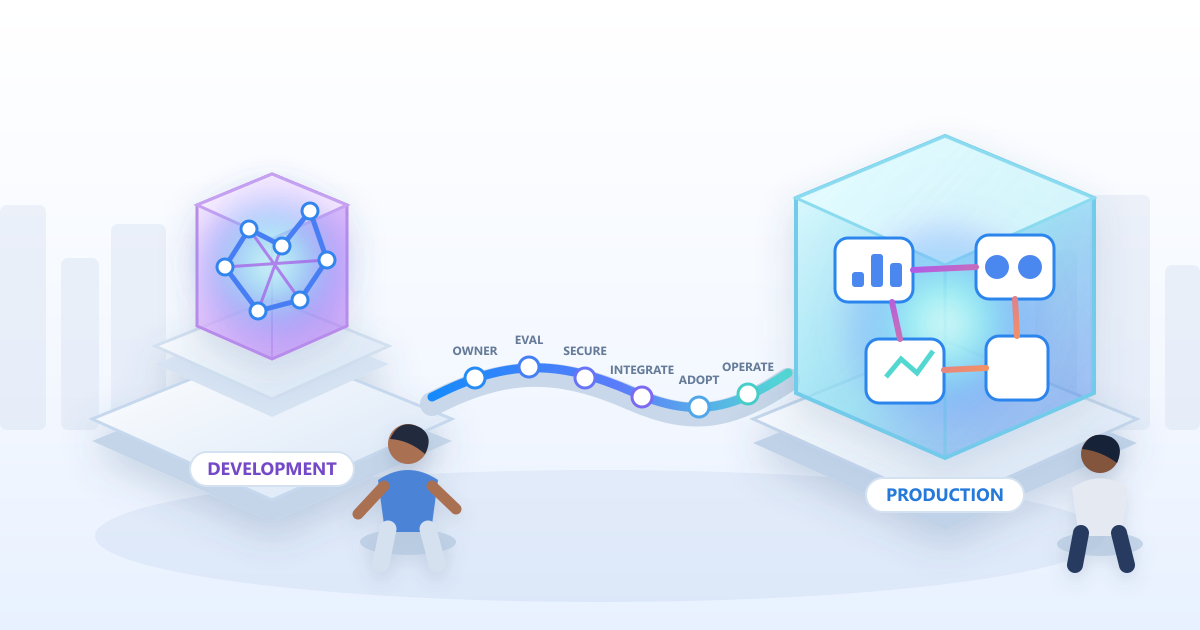
Development and production make different promises
Development reduces uncertainty about an idea. It usually uses a bounded scenario, known data, cooperative inputs, and builders who understand every limitation.
Production introduces ambiguous requests, unavailable dependencies, varied permissions, changing models, malicious input, audit requirements, and users who were not part of the design process.
That creates a predictable trap: teams estimate production work from the application they can see rather than the controls the development environment has not needed yet.
| Successful development proves | An enterprise system must prove |
|---|---|
| The capability can work | The complete workflow works reliably |
| Selected answers look useful | Quality remains measurable across representative scenarios |
| Data can be retrieved | Users receive only authorized data |
| A tool can be called | Actions are constrained, traceable, and recoverable |
| The experience is compelling | People adopt it in daily work |
| A request appears inexpensive | Total operating cost remains sustainable |
None of the claims on the right follows automatically from the claims on the left.
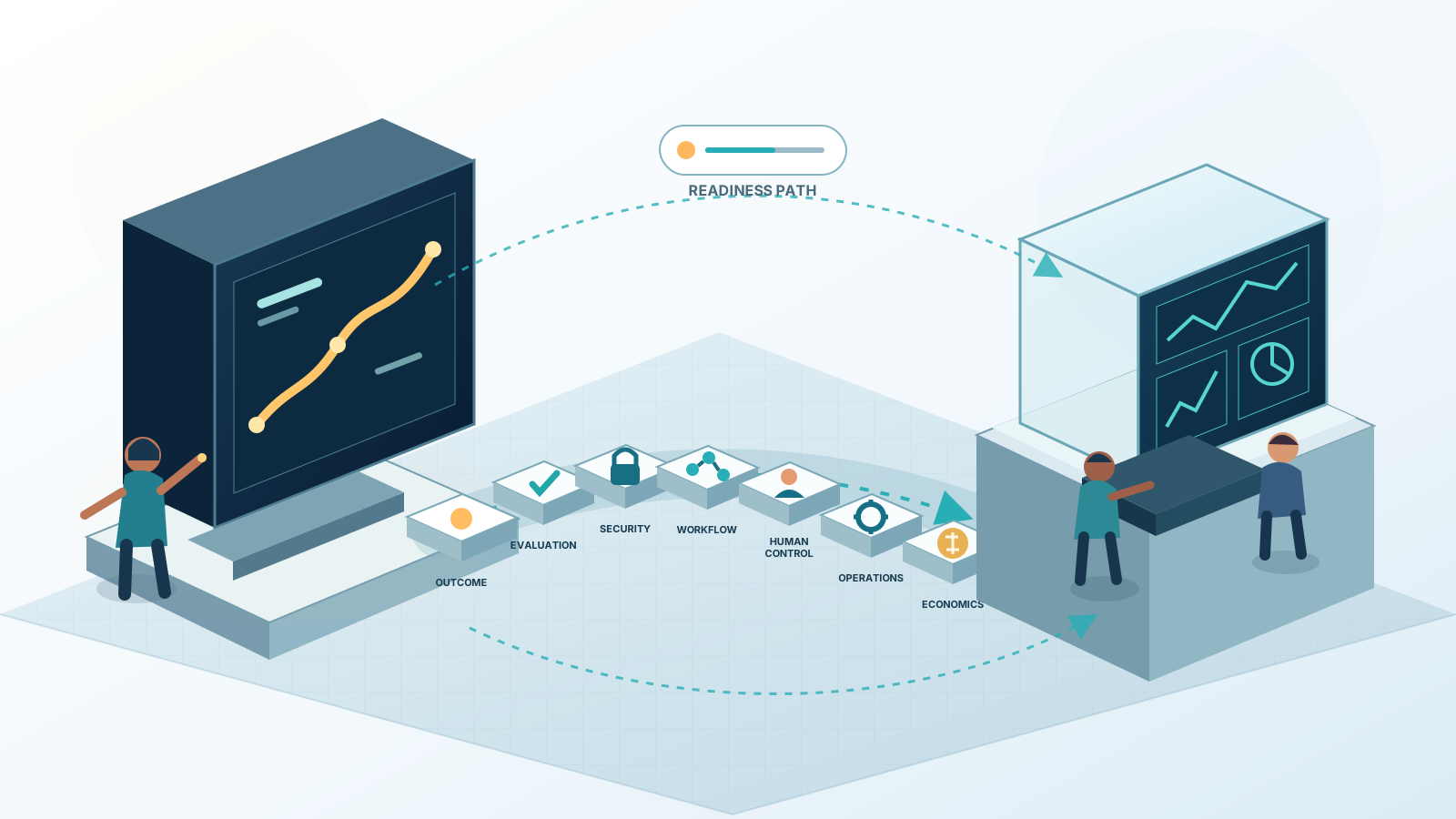
The seven gaps hidden by successful development
1. The outcome gap
Development often measures reactions: the answer looked good, the workflow felt faster, or the agent completed an impressive task. Production needs an explicit business outcome.
Define what should improve, for whom, and how it will be measured. A support assistant might target faster resolution while maintaining answer quality. A knowledge agent might reduce search time while preserving source traceability.
If the team cannot identify the operational measure, it cannot distinguish a valuable system from an interesting one.
2. The evaluation gap
Generative AI behavior can vary, so traditional software tests are necessary but insufficient.
Build evaluation data that represents real work. Include routine requests, ambiguous requests, missing evidence, conflicting sources, unsafe requests, adversarial attempts, and situations where abstaining is correct. Measure qualities tied to the use case, such as groundedness, completeness, task success, citation accuracy, tool-call accuracy, safety, and policy compliance.
Microsoft’s Azure Well-Architected guidance distinguishes model evaluation from testing the complete system. It also recommends representative data, multiple metrics, and regression testing when changes are introduced.
3. The data and security gap
Development may use broad access to a carefully prepared data set. Production must preserve identity and authorization through retrieval, generation, and action.
Test whether permissions are enforced at query time, sensitive inputs and outputs are protected, access is recorded, and untrusted retrieved content can alter system behavior. Prompt injection, excessive tool permissions, and data leakage should be treated as system threats, not merely model problems.
An AI interface must not become a convenient route around controls protecting the underlying systems.
4. The workflow gap
A capability can be technically strong and still fail because it sits outside the work.
If users must copy an answer into another application, rebuild its evidence manually, or call the development team whenever an integration fails, the capability has not become a dependable workflow.
Production design includes authentication, integration contracts, timeouts, retries, idempotency where relevant, approval steps, and explicit behavior when automation cannot continue.
5. The human-control gap
Not every action should be autonomous.
Classify actions by consequence, sensitivity, and reversibility. Drafting an internal response may require review. Reading approved knowledge may be automatic. Sending an external message or changing a financial record may require explicit authorization.
A useful human-control design states who reviews, what evidence they receive, what they must verify, and whether they have enough time and authority to reject the action.
6. The operations gap
A solution in development is watched by its builders. A system needs observability and an operating owner.
Trace model calls, retrieval, tool invocation, latency, errors, and the evidence used to generate important outputs, subject to privacy and retention requirements. Monitor both software health and AI quality.
Microsoft Foundry documents evaluation, monitoring, and distributed tracing as complementary observability capabilities. Its current guidance includes visibility into model calls, tool invocations, operational metrics, and sampled production evaluation.
Tools help, but the broader principle matters more: if operators cannot reconstruct what happened, they cannot support the system responsibly.
7. The economics and adoption gap
Model consumption is only one part of production economics. Include retrieval, storage, networking, evaluation, monitoring, support, human review, and the cost of errors.
Then examine adoption. Does the system save enough effort to justify changing behavior? Is it fast enough? Can users understand its evidence and limitations? A system that works but is not trusted will be bypassed. A system that is trusted but uneconomical may not survive its budget review.
A practical path from development to system
Stage 1: Frame the decision
Write a short system brief containing the intended users, measurable outcome, prohibited uses, data boundaries, action boundaries, owners, and conditions that would stop the initiative.
Stage 2: Build evidence
Create the evaluation set and baseline before expanding access. Threat-model the complete architecture, including retrieval, tools, memory, integrations, and downstream actions. Estimate cost using realistic workflow traces and expected volume.
Stage 3: Run a controlled pilot
Pilot with representative users and production-like permissions. Instrument critical steps. Keep consequential actions behind approval. Compare outcomes with the baseline and collect failure reports, not only satisfaction scores.
Stage 4: Operate and improve
Release through versioned changes. Re-evaluate after material changes to models, prompts, data, tools, or permissions. Review incidents, quality, adoption, and cost on a defined cadence. Give an accountable owner authority to restrict, roll back, or stop the system.
Trade-offs to make explicitly
Production readiness does not eliminate all risk. It makes choices visible.
- Capability versus control: More tools and data can improve usefulness while increasing exposure and consequence.
- Autonomy versus reversibility: Automation reduces friction, but approval can be appropriate when an action is difficult to undo.
- Personalization versus privacy: More context can improve relevance while increasing data-handling obligations.
- Quality versus latency and cost: Additional retrieval, model calls, and evaluation can improve confidence while slowing the experience.
- Release speed versus evidence: A narrow, measured release can be easier to expand than a broad launch followed by incident-driven controls.
There is no universal setting. The right balance depends on the use case, affected people, legal context, and organizational risk tolerance.
The production decision checklist
Before release, require clear evidence for these questions:
- Is the intended outcome measurable and owned?
- Are quality and risk thresholds documented?
- Does evaluation cover normal, ambiguous, adversarial, and refusal scenarios?
- Are identity, authorization, privacy, and data boundaries enforced end to end?
- Are actions limited according to consequence and reversibility?
- Can operators trace failures and restore a safe state?
- Are support, incident response, and change ownership assigned?
- Has cost been modeled at realistic volume?
- Did representative users demonstrate value in a controlled pilot?
- Is there a defined reason to pause or retire the system?
A “no” does not always mean cancel the project. It means the unresolved risk must be mitigated, accepted by the right authority, or kept outside the production boundary.
Closing thought
The first successful result in development deserves celebration. It is evidence that the idea may merit further investment.
It is not evidence that the enterprise should trust the system yet.
The teams that cross this gap surround capability with measurable outcomes, representative evaluation, security, workflow design, human authority, observability, economics, and ownership.
Development proves possibility. An enterprise system earns trust.
Sources
Amrutha Satishkumar
Data & AI Solution Engineer at Microsoft